
Africa’s growing population continues to face substantial health challenges, including limited access to licensed medicines and uneven regulatory capacity. Although regulatory systems are strengthening, most national regulatory authorities in the WHO African Region remain below maturity level 3, reflecting continuing gaps in governance, financing, workforce capability and digitalisation.
Against this backdrop, pathways for supplying unlicensed medicines, often described as named-patient, compassionate-use, managed-access or expanded-access pathways, can help address urgent unmet medical needs when suitable licensed treatment options are unavailable.
However, gaps in legislation, regulatory guidance and enforcement can hinder the consistent, timely and appropriately controlled supply of these medicines across the continent.
Although unlicensed-medicine pathways are well established in several developed markets, comparable frameworks remain limited or inconsistently defined across sub-Saharan Africa (SSA). Applications are generally submitted by treating healthcare professionals on behalf of patients who require a specific unregistered medicine. Depending on the jurisdiction, applicants may also need to demonstrate that the product has been assessed or authorised by a recognised reference regulatory authority.
Case Studies: Unlicensed Medicine Supply in Sub-Saharan Africa
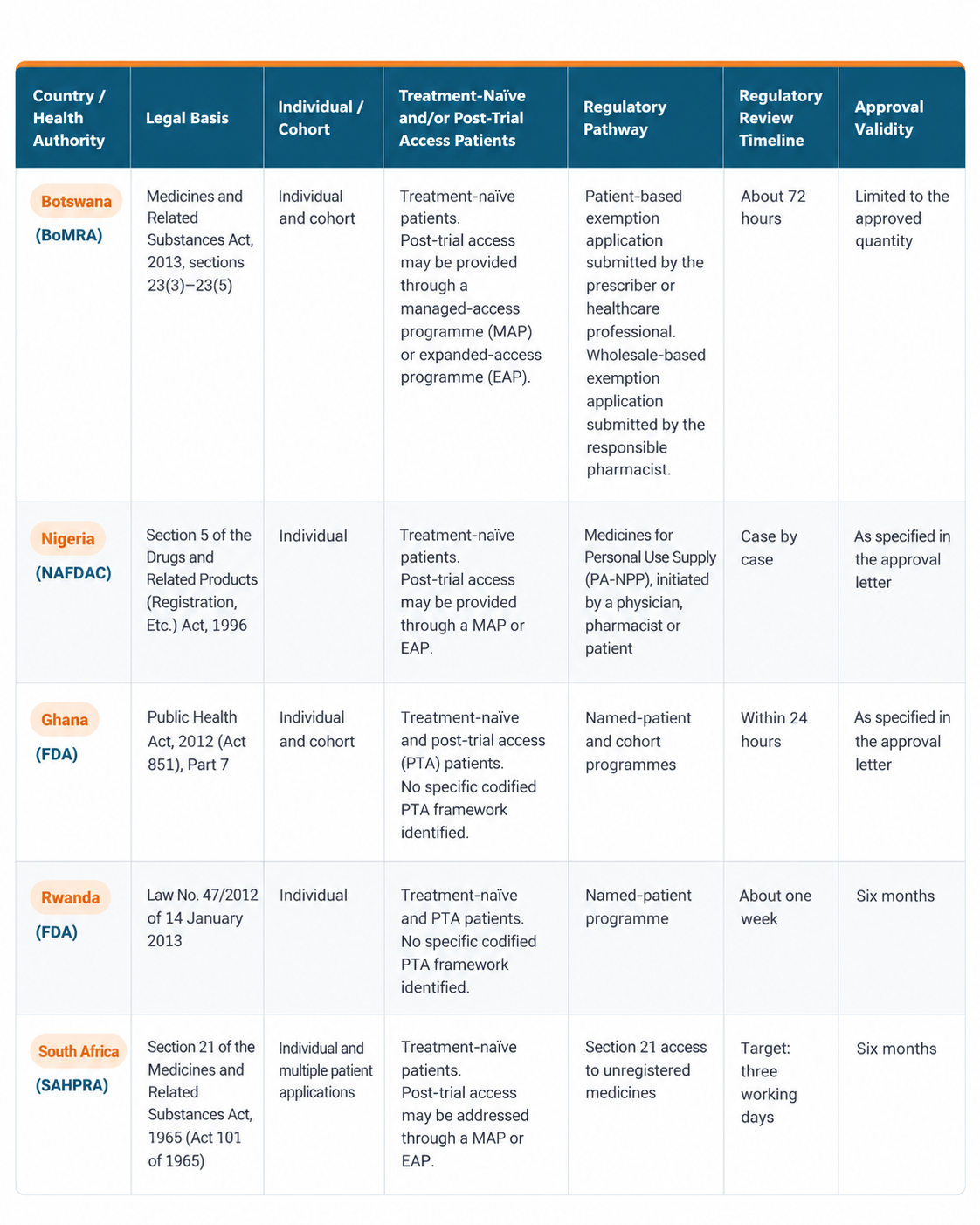
How Can Health Authorities Address These Challenges?
To improve timely and equitable access to unlicensed medicines in sub-Saharan Africa, health authorities should prioritize the following actions:
- Strengthen regulatory systems: Enhance regulatory capacity across product assessment, market authorization and enforcement. Clearer requirements and more efficient submission, evaluation and decision-making processes can reduce administrative burden, lower costs and expedite access to unlicensed medicines. Regional initiatives such as the African Medicines Agency (AMA) can support this objective.
- Promote regional partnerships: Strengthen collaboration among countries to support information sharing, joint assessments, reliance on inspection outcomes, pooled purchasing and more resilient distribution networks. Cooperation between the Botswana Medicines Regulatory Authority (BoMRA) and the South African Health Products Regulatory Authority (SAHPRA) illustrates how regional partnerships can strengthen medicines regulation.
- Build regulatory capability: Establish regional networks that pool regulatory expertise and resources for dossier assessment and the expedited review of essential medicines. Targeted training, sustainable funding and access to specialist expertise can help health authorities reduce approval delays and strengthen oversight of substandard or falsified products.
- Improve transparency and harmonization: Establish technical expert working groups across key regulatory functions and align regulatory criteria through common guidelines and procedures. Greater transparency and consistency can facilitate reliance and mutual recognition, reduce barriers to access and strengthen safeguards against substandard and falsified medicines. Rwanda FDA and SAHPRA provide useful examples of increasingly transparent and harmonized processes.
- Streamline approval processes: Standardize review timelines and publish clear requirements for unlicensed-medicine applications. Predictable, proportionate and efficient pathways can reduce the time and resources required to obtain access. Ghana FDA, for example, indicates a review period of approximately 24 hours for these applications.
- Strengthen supply chains and local manufacturing: Invest in resilient regional supply chains and quality-assured local pharmaceutical manufacturing to reduce avoidable dependence on imports and improve medicine availability. Regulatory strengthening should accompany manufacturing expansion so that locally produced products consistently meet applicable quality, safety and efficacy standards.
- Improve access to health authority websites and portals: Maintain reliable digital platforms that provide current guidance, application requirements, forms, fees, timelines and submission channels. Governments should invest in information technology infrastructure, staffing and maintenance to strengthen transparency, accountability and service continuity.
- Expand stakeholder awareness and professional training: Provide healthcare professionals and other relevant stakeholders with practical guidance on eligibility criteria, application procedures, appropriate use, pharmacovigilance and medication safety. Accessible training materials and digital reporting tools can support more consistent implementation and safer patient access.
Conclusion
Sub Saharan Africa is making important progress in strengthening the regulation of unlicensed medicines. The African Medicines Agency, regional harmonization initiatives and greater use of reliance pathways create opportunities to improve timely access to medicines of appropriate quality, safety and efficacy. Sustained progress will require coordinated action to address fragmented requirements, limited regulatory resources, inconsistent transparency, supply chain weaknesses and the circulation of substandard and falsified products. Clear, proportionate and enforceable pathways, supported by appropriate clinical oversight, pharmacovigilance and supply controls, are essential to protect public health while enabling patients to access treatment when suitable licensed alternatives are unavailable.