
For some participants in a clinical trial, the end of a clinical trial does not coincide with the end of their medical need. Patients who continue to derive clinical benefit from an investigational therapy may face a treatment gap between trial completion and commercial availability.
Post-Trial Access (PTA) seeks to address this challenge by providing continued access to treatment after participation in a clinical trial has ended. Once viewed primarily as an ethical consideration, PTA is increasingly becoming a strategic and operational requirement that Sponsors must plan for early in clinical development. Recent developments in international ethical guidance, regulatory expectations, and country-specific legislation have accelerated this shift.
What is Post-Trial Access (PTA)?
PTA refers to the continued provision of an investigational medicinal product to participants after completion of a clinical trial when:
- The patient is deriving clinical benefit from treatment.
- No satisfactory alternative treatment exists.
- Continued access is considered medically appropriate by the treating physician.
- Access aligns with applicable regulatory and ethical requirements
The concept originates from Article 34 of the Declaration of Helsinki, which states that Sponsors, researchers, and host country governments should make provisions for PTA for participants who still require an intervention identified as beneficial during the study.
PTA is particularly relevant in:
- Rare diseases
- Oncology
- Advanced therapies
- Long-term chronic diseases
- Conditions with limited therapeutic alternatives
For these patients, discontinuation of treatment may result in disease progression, deterioration of health status, or loss of clinical benefit.
How are PTAs Supplied?
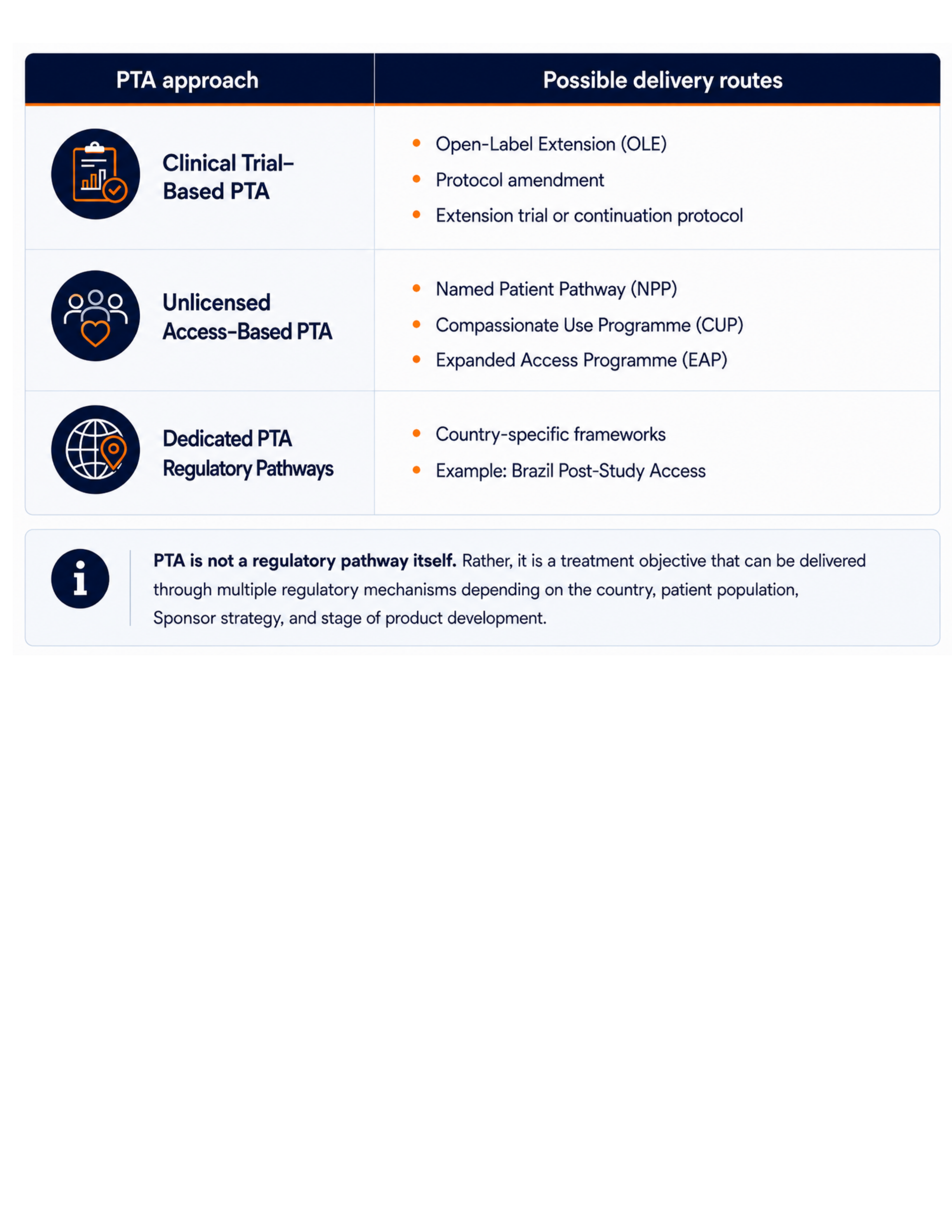
One of the biggest misconceptions is that PTA is a single regulatory pathway. In reality, PTA is a ‘clinical objective’ that can be delivered through several different regulatory mechanisms depending on the country, product lifecycle stage, patient numbers, and Sponsor strategy.
Broadly speaking, PTA can be supplied through the following main categories:
Evolving Regulatory Landscape of PTA
PTA has traditionally been driven by ethical expectations rather than enforceable legislation. However, the landscape is changing.
Several countries now impose explicit post-trial obligations under national laws, while regulators increasingly expect Sponsors to demonstrate how participants and their after-care will be managed after study completion.
A particularly significant development is the on-going revision of the Declaration of Helsinki.
According to updates in 2024, Article 34 is strengthened to require greater transparency regarding post-trial provisions. Sponsors should determine and communicate their PTA plans much earlier, including consideration during trial design and informed consent development.
Although implementation will ultimately depend on ethics committees and local regulatory adoption, the practical message is already evident: PTA planning is moving upstream from a study close-out activity to a clinical development planning activity.
Why Early Planning Matters – The Operational Considerations
One of the most common reasons PTA programs experience difficulties is that planning begins too late.
Many Sponsors only start considering PTA once primary endpoint readout or trial close-out approaches. At that stage, critical decisions regarding patient commitments, regulatory pathways, supply forecasting, and operational ownership may already be constrained.
Early planning delivers several advantages:
- Avoids treatment interruptions between the end of a clinical trial and set-up of the appropriate PTA pathway.
- Supports ethical commitments – provides favourable reputational and ethical obligations to be met.
- Enables accurate supply forecasting – manufacture of the IMP is not quick and easy and ensuring there is sufficient stock to support PTAs is necessary to be communicated to QA and Supply Chain teams well in advance.
- Enables appropriate budget is secured to ensure supply and support of PTAs.
- Improves Exit Strategy Planning – every PTA program requires a clearly defined endpoint. Without an exit strategy, program can become operationally and financially unsustainable.
Common exit triggers include:
- Marketing authorisation approval
- Reimbursement availability
- Availability of an alternative therapy
- Defined regulatory duration limits
What is WEP’s Strategic Advice to Clients
- Assess PTA requirements during clinical trial protocol development
- PTA planning should begin during trial design, not trial closure.
- Sponsors should evaluate likely patient need, anticipated duration of access, and possible regulatory pathways before first patient enrolment.
- Align Clinical, Regulatory and Commercial Strategies, with PTA in mind, by bringing together the key stakeholders of an Asset team
PTA sits at the intersection of multiple functions. The optimal pathway may depend on:
- Commercial launch plans
- Registration timelines
- Geographic expansion strategy
- Supply chain capabilities
- Long-term reimbursement expectations
A PTA strategy developed in isolation rarely succeeds and can lead to last-minute decision-making that cost the organization money.
- Categorise countries early and into strategic ‘buckets’
Countries can generally be grouped into (as stated in the table above):
- Clinical trial framework countries (OLEs/extensions)
- NPP countries
- CUP countries
- Dedicated PTA pathway countries
- Countries where PTA may not be feasible
Understanding which pathways are feasible in which country early on can help develop and optimal strategy for PTA that leverages streamlined operational planning and budgeting – e.g. label strategy, protocol requirements, Sponsor vs HCP burden.
- Understand the long-term commitment
Sponsors should carefully assess:
- Duration of obligation determined by regulation and commitment
- Mandatory PTA requirements
- Commercialization plans
- Future supply sourcing of the drug
- Cost implications for running PTA
In some jurisdictions, post-trial obligations may continue for years, e.g. Brazil, Turkey.
- IMPORTANT: Always have an exit strategy
One consistent message emerging from industry experience is simple:
- Every PTA program should begin with the end in mind.
- Sponsors should define clear transition criteria, communicate expectations early, and establish contingency plans for delays in registration, reimbursement, or supply continuity.
Conclusion
PTA is no longer merely an ethical discussion occurring at the end of a clinical trial. It is becoming an increasingly important component of global development strategy.
As regulatory expectations evolve and Article 34 of the Declaration of Helsinki continues to shape stakeholder expectations, Sponsors that integrate PTA planning early will be best positioned to meet patient needs, fulfil ethical commitments, be seen in a favourable light within the clinical community and avoid operational challenges.
Ultimately, successful PTA programs are not defined by the regulatory pathway selected. They are defined by thoughtful planning, cross-functional alignment, and a clear strategy for ensuring that patients who benefit from treatment are not left behind when a clinical trial ends.
WEP Clinical is a global leader in Access Program management and clinical trial services, operating across more than 150 countries. To speak with our regulatory team about structuring your access program for success, click here to contact us.